
Frequently Asked Questions
THE IGUANA HOUSE
1. Why stay at Iguana House Belize?
Iguana House offers something increasingly hard to find on Ambergris Caye: a quiet, private place where your group can settle in and make the house your own for the week.
Mornings often start with coffee in a rocking chair on the old hardwood deck overlooking the Caribbean before breakfast. The house itself has history and character. It is comfortable, immaculate and air-conditioned, but intentionally laid-back and casual. We are in a quieter part of Ambergris Caye, away from the busier resort atmosphere.
For fishing groups, the little things matter too. Breakfast is ready before the fishing day begins, packed lunches are provided daily, and laundry is done when you return. Most anglers can comfortably travel with just two or three fishing outfits. Gear can stay organized, rods can be ready, and the private dock makes getting on and off the water simple.
Perhaps the biggest difference is that the house belongs to your group while you’re here. You aren’t staying in separate lodge rooms and trying to figure out where everyone went after the fishing day. You’re together. We are around and available whenever you want help—with fishing, gear, casting, planning or simply talking through the day—but we also understand when a group wants the place to itself.
It’s funny how rarely the television gets turned on at Iguana House unless there’s a game somebody really wants to watch. People end up on the deck, talking about the day, having dinner, watching the water and enjoying each other’s company.
That’s really what staying here feels like: private, comfortable, unhurried and connected to the people you came to Belize with.
2. What makes Iguana House different from other Belize vacation rentals?
Iguana House is somewhere between a private vacation home and a traditional fishing lodge, with some of the best parts of both.
The house is private to a small group, with comfortable air-conditioned sleeping quarters, private bathrooms, a large waterfront deck and private dock. Meals are an important part of the experience, with excellent breakfasts, packed lunches and dinners that guests routinely tell us are among the best meals they have during their time on Ambergris Caye.
What really makes Iguana House different, though, is the fishing experience. Guests can combine guided fishing with an unusual amount of quality DIY fishing for bonefish, permit, tarpon and triggerfish. They can fish before or after a guided day, explore on their own, work on casting and presentation between fishing days, and get as much or as little help from us as they want.
We are generally at the house during fishing weeks and available to help guests prepare gear, work on casting, plan DIY fishing, talk through what happened on the water, or simply get ready for the next day. We also know when to disappear. Some groups want a lot of interaction and others want the privacy of having a beautiful house on the Caribbean to themselves.
We deliberately keep the atmosphere relaxed and without pretense. Saltwater fly fishing is difficult, and mistakes are part of becoming good at it. We try to help anglers turn those mistakes into useful information rather than treating every missed shot or lost fish as a failure.
That combination—private house, excellent food, guided and DIY fishing, hands-on help when wanted, and plenty for non-anglers and families to enjoy—is what makes Iguana House different.
3. Is Iguana House good for fly fishing vacations?
Absolutely. Iguana House was built around the kind of fly-fishing trip we ourselves prefer: serious fishing without the pressure, crowds or rigid structure of a traditional fishing lodge.
Iguana House accommodates up to eight anglers, keeping the experience small and private rather than creating a large lodge environment or competition among dozens of anglers. Larger groups can be considered upon request.
Skill levels can range from beginners to highly experienced saltwater anglers. We believe becoming a good saltwater fly fisherman is a process. We’ve lived the missed shots, lost fish, bad casts and difficult days ourselves, and we try to create an environment where anglers can learn from those experiences rather than feel judged by them.
The fishing week is also unusually flexible. Guests can combine professionally guided days with DIY fishing, add guided days when guide availability allows, practice casting between fishing days, fish before or after a guided day, or take a day away from fly fishing altogether. Groups can even split up—some guests fishing while others snorkel, explore the island, spend time at the beach or take another excursion.
DIY fishing is a particularly important part of Iguana House. Ambergris Caye offers unusual opportunities to independently pursue bonefish, permit, tarpon and triggerfish without paying for a boat every time you want to fish. We help guests understand where and how to do it and can provide individual casting and fishing instruction as desired.
Most importantly, guests have a relationship with the owners rather than simply interacting with lodge staff. We are generally there for the majority of serious fishing weeks, helping as much or as little as the group wants while the house itself remains theirs.
It’s serious saltwater fishing in an unserious atmosphere
4. Can beginners enjoy fly fishing in Belize?
Yes, but preparation makes an enormous difference. Saltwater fly fishing has a steep learning curve, and many first-time anglers arrive not yet knowing what they don’t know. We try to change that before their first guided fishing day.
For new anglers, preparation can begin before the trip with a Zoom call to discuss casting, practice drills and what to expect, along with recommended casting videos and exercises they can work on at home.
Once at Iguana House, we generally don’t put a brand-new saltwater angler straight onto a guide boat on the first day. We prefer to use an initial DIY day for one-on-one casting instruction and preparation. We can work on the dock or beach on the double haul, timing, line management and the transition from freshwater trout casting to loading a saltwater rod.
We also teach the parts of a guided fishing day that aren’t obvious from casting videos: how two anglers work together on a panga, how the person not on the bow can help with line management and spotting fish, how to communicate with a guide, and how to explain what you want to learn.
Expectations matter too. A beginner may benefit from targeting bonefish before focusing entirely on permit because many of the presentation and hook-set skills transfer. Tarpon can require a different strategy. We help anglers understand those choices and communicate their goals to their guide.
Most importantly, beginners don’t need to pretend they’re experienced. Saltwater fly fishing is hard. Everyone misses fish. Everyone makes mistakes. The objective is to make those mistakes useful and gradually turn them into skills.
5. What’s included when booking Iguana House?
Our Base Package is also our All-DIY Package. Unless a guest requests otherwise, it includes:
- Private lodging at Iguana House
- Breakfast, packed lunch and dinner daily
- Appetizers before dinner
- Two local alcoholic beverages per guest per day
- Local air transfers
- Local transportation between the San Pedro airport and Iguana House
- Golf cart rental
- Maid service
- Daily laundry service
- Local taxes
A 5% service charge is added to all packages.
Guided fishing can then be added depending on the package selected. Guests can choose a combination of guided and DIY fishing rather than being locked into a full week of guided fishing.
We can also help arrange other activities and excursions for anglers and non-anglers. Guided fishing days are best reserved in advance so we can secure our preferred guides, although additional days can often be added during the trip when guides are available.
The idea behind the Base Package is simple: once you arrive on Ambergris Caye, most of the logistics of the week are already handled. You can concentrate on fishing, exploring the island and enjoying the people you came with.
6. How far is Iguana House from San Pedro?
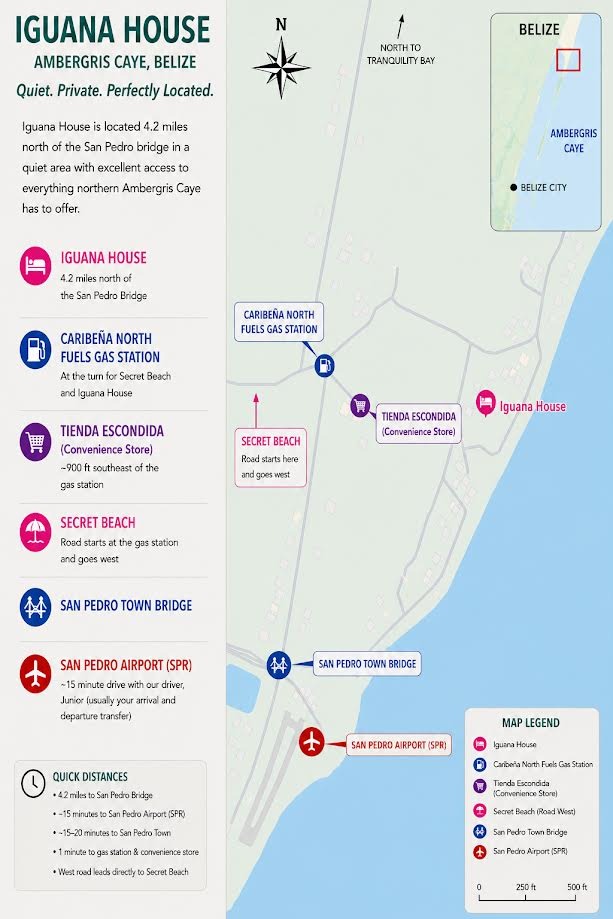
Iguana House is located about 4.2 miles north of the San Pedro Town Bridge, in a quiet area away from the main road but with excellent access to San Pedro and northern Ambergris Caye.
For most arrivals and departures, our taxi driver, Junior, provides transportation between the San Pedro airport and Iguana House. The drive typically takes about 15 minutes and is the fastest and easiest way to get guests and their luggage to and from the house.
Iguana House is located near the junction where the road continues north toward Tranquility Bay and the road west toward Secret Beach begins. This makes it a convenient jumping-off point for exploring the island by golf cart while keeping the house itself quiet and removed from the main road and traffic.
Caribeña North Fuels Gas Station is located at the Secret Beach turn, and Tienda Escondida convenience store is also nearby. Both are about a one-minute golf-cart ride from Iguana House.
7. Can you fish near Iguana House / Ambergris Caye?
Absolutely. One of the things that makes Iguana House particularly well suited for DIY fly fishing is its location on the reef side of Ambergris Caye. The water between the island and the Belize Barrier Reef creates a unique, protected fishery extending north past Tranquility Bay toward Rocky Point.
The DIY fishing along this corridor is predominantly a bonefish and permit fishery, with opportunities for jacks, triggerfish and tarpon as well. Much of it is wade fishing and sight fishing accessed by golf cart—moving along the island, checking water conditions and looking for fish rather than being limited to one particular flat or stretch of shoreline.
Some days, the best opportunities are surprisingly close to home. We have had excellent shots at bonefish and permit on the flats and from the docks directly in front of Iguana House. Other days, conditions tell us to move.
Wind can stir up sand and debris, heavy rain can affect visibility, and seasonal sargassum can influence portions of the shoreline. When visibility around Iguana House isn’t ideal, water clarity often improves as we travel farther north. We frequently fish around Tranquility Bay and continue north toward Rocky Point when conditions warrant it.
That ability to move and adapt is an important part of DIY fishing at Iguana House. Rather than depending on one small stretch of water, anglers can explore miles of reef-side habitat and adjust their fishing to the conditions that particular day.
8. What is the best time of year to fish Ambergris Caye?
We could give you the standard fishing-lodge calendar: January—good. March—excellent. May—prime. But after years of fishing Ambergris Caye, we don’t think that’s an honest way to answer the question.
Ambergris Caye is a year-round fishery, and conditions matter more than the calendar.
There are seasonal tendencies. In our experience, the warmer summer months often bring calmer conditions and more fish activity, while the winter and spring months have historically been especially popular with visiting anglers who want to escape colder weather farther north.
January through March—and sometimes into May—are traditionally popular fishing months. March and April can bring stronger winds, particularly around Easter, although those same months can also produce excellent fishing. May often becomes calmer. We particularly like November and January, while December can bring slightly cooler, very comfortable weather. Temperatures remain warm throughout the year, generally ranging from the upper 70s into the mid-80s.
But those are tendencies, not promises.
Over the last five to ten years, weather patterns have become less predictable. Wind, cloud cover, rain, water clarity and temperature can have a much greater effect on a particular fishing day than the month printed on the calendar.
We’ve caught some of our best permit well outside what might traditionally be called the “best season,” simply because we happened to be there when the conditions came together.
The name of the game is being there when it’s good—and predicting exactly when that will happen is virtually impossible.
For that reason, anglers who have the flexibility to stay a little longer often have an advantage. A longer trip gives you more opportunity to wait out a weather day and capitalize when the wind, light and water conditions line up for sight fishing.
9. Can Iguana House arrange fishing guides?
Absolutely. Iguana House works with a group of our favorite independent local guides, and we can arrange guided fishing as part of a fully guided trip or combine guided days with DIY fishing.
The most important thing is to decide as early as possible how many guided days you want, which days you want them, and how many boats your group will need. Our guides are independent contractors who also book their own clients, so establishing those dates early gives us the best opportunity to reserve the guides we know and prefer for your trip.
Guided days can usually be added after you arrive if guides are available, but the earlier we know, the better.
We love DIY fishing and it’s a major part of the Iguana House experience, but we don’t pretend DIY and guided fishing offer the same odds. Fishing from a panga with an experienced local guide generally provides considerably more opportunities to find and catch fish. Guides can cover much more water, reach different fisheries and adjust throughout the day when wind, clouds, water clarity or other conditions make shore-based sight fishing difficult.
Guided fishing is a premium part of a saltwater fly-fishing trip, but for anglers whose priority is maximizing their opportunities at bonefish, permit and tarpon, it is usually money well spent. That’s one reason we like the hybrid approach: guided days provide the greatest access and productivity, while DIY days provide freedom, exploration and the satisfaction of finding fish on your own.
Guided boats normally fish two anglers per panga. A panga costs $600 per day, plus tip. With two anglers, that’s $300 per person. If an angler chooses or needs to fish alone, that angler has the boat—and every fishing opportunity—to themselves—but pays the full $600 boat cost. This two-angler structure is standard throughout saltwater fly fishing, but it’s something we like to make clear when groups with an odd number of anglers are planning their guided days.
10. Is Iguana House family-friendly?
Yes, particularly for families with older children who are comfortable around the water. Iguana House has hosted families of five and six who have described the house as working perfectly for their family, and the private-house setting is a big reason why.
Unlike a traditional fishing lodge where much of the trip revolves around a shared fishing schedule, families at Iguana House have the freedom to build different days around different interests. Some family members can spend the day fishing while others snorkel, dive, explore San Pedro, visit Secret Beach, take an excursion or simply relax at the house. Everyone can then come back together at the end of the day for appetizers and dinner.
Because Iguana House is a waterfront Caribbean home with a dock and immediate access to the sea, it is not an ideal destination for babies or toddlers. We recommend that children be old enough to travel without a car seat and be able to swim. Parents should also be comfortable supervising their children around the water, dock and shoreline. Even adult anglers commonly wear saltwater booties when wading because coral and other marine life can be present underfoot.
The house itself lends itself particularly well to families and multigenerational groups. Each bedroom has its own bathroom, there is plenty of space to spread out, and having the entire property for your group allows a family to settle into its own rhythm rather than adapting to a resort or lodge schedule.
For families with anglers and non-anglers, that flexibility may be one of Iguana House’s greatest advantages: everyone can have a different Belize experience during the day and still be on the same family vacation.
11. What activities are available besides fishing at Iguana House Belize?
Plenty—and sometimes the best choice is doing absolutely nothing. Iguana House is a private waterfront home, and an off day can be as simple as sleeping in, relaxing on the deck, reading in a hammock, enjoying good food and drinks, and watching the Caribbean go by.
For guests who want an adventure, some of our favorite off-day trips leave directly from our dock, making them easy to fit into the week without spending hours traveling.
One guest favorite is a day on the water with Capt. Robert of Hogzilla, a master free diver and spearfisherman. The day can include reef fishing, spearfishing, lobster hunting and snorkeling, followed by a beach barbecue featuring fish and lobster caught that day. The trip typically runs from about 8:30 a.m. to 4:30 p.m. and explores the reef and waters north of Iguana House.
No pressure. All fun. That’s what this day is.
And because this is Iguana House, you don’t necessarily have to leave the fly rod behind. Capt. Robert is happy to drop anglers along stretches of beach up north where they can look for opportunities at bonefish and permit.
Other easy favorites include snorkeling and beach-barbecue trips and combinations such as a half-day snorkeling with a half-day visit to Caye Caulker. Many excursions can pick guests up directly at the Iguana House dock and return them there afterward.
Guests can also explore San Pedro and Ambergris Caye by golf cart, visit Secret Beach, snorkel or dive sites along the Belize Barrier Reef, or simply head into town for restaurants, bars and local culture.
For those who want to explore mainland Belize, Maya ruins, cave tubing, ziplining and the Belize Zoo are all possible day trips. These require considerably more travel than island and reef activities, so we generally help guests understand the logistics and choose what makes sense for their week.
The advantage of staying at Iguana House is that a fishing trip doesn’t have to be only about fishing. Anglers can fish hard while spouses, friends or family members have completely different days—or everyone can take a day off together and go have some fun.
12. How do you get to Iguana House Belize?
One of the advantages of a saltwater fly-fishing trip to Belize is how easy it is to get here from the United States.
Guests fly internationally into Philip S. W. Goldson International Airport (BZE) near Belize City. Nonstop service to Belize is available from a growing number of major U.S. cities, with some routes operating seasonally. Travelers from many other U.S. cities can reach Belize easily with a single connection through a major hub.
Flight times are surprisingly short. Houston is roughly 2½ hours from Belize, while Denver is about 4 hours, and even Boston and the West Coast are roughly 5–7 hours nonstop depending on the city.
Guests don’t need to live in one of those gateway cities for Belize to be easy to reach. We regularly host anglers from places such as Boise, Bozeman and other Montana cities, Albuquerque, Salt Lake City, Spokane, Portland, Tucson, Oklahoma City, Cleveland, Indianapolis, Grand Rapids, St. Louis and throughout Pennsylvania and the Midwest. From many secondary U.S. cities, getting to Belize typically means one connection through a major hub. A well-timed itinerary can often put you in Belize City in roughly 5–8 hours of scheduled travel, depending on your starting point and connection.
We have also hosted international guests from the United Kingdom, Germany and elsewhere in Europe. European travel naturally takes longer and generally requires a connection, but once guests reach Belize City, the final leg to Iguana House is remarkably short.
Once you land at BZE, the long-distance travel is essentially over.
Most Iguana House guests take a short local flight from BZE to San Pedro on Ambergris Caye. The flight is approximately 15 minutes. When you arrive in San Pedro, transportation between the airport and Iguana House is arranged as part of our packages.
For guests who prefer not to fly the final leg, traveling to San Pedro by water taxi is also possible, although it requires a ground transfer from the international airport to the water-taxi terminal and takes considerably longer.
The accessibility is one of the things that makes Belize unusual among serious saltwater fly-fishing destinations. Some remote flats fisheries require several additional hours of driving or boat travel after the international flight. With Iguana House, you can leave the United States in the morning, take a short local flight across the Caribbean, arrive at the house and—in many cases—still have enough daylight to rig a rod and go fishing that same day.
For anglers trying to maximize fishing time, that matters.
13. What meal packages are available at Iguana House Belize?
NOTE FOR LANCE: We are no longer offering a separate meal package. Meals are included in the Base Package, so please remove any older website language referring to an optional meal package.
Food is an important part of the Iguana House experience. Glenda and Mary Alice prepare meals from scratch using fresh, local ingredients from Belize. The menu ranges from seafood to meat and local Belizean flavors, and meals are adjusted around the preferences, dislikes, dietary needs and allergies of each group.
A typical breakfast might include eggs, meat, fresh-baked sourdough bread and fresh fruit. Guests heading out fishing or exploring can take a packed lunch—one favorite is shrimp or chicken quesadillas with Mary Alice’s special sauce and fresh fruit.
Before dinner, appetizers are served. One guest favorite from Glenda is a Belizean curry tostada with chicken, lettuce, onion and tomato.
Dinner might feature fresh fish or meat, seasoned and cooked to perfection, with coconut rice, fresh salad and homemade dressing. Seafood varies with availability and season and can include Belizean favorites such as lobster, grouper, deep-water snapper, snook and conch. Dessert changes throughout the week, ranging from homemade cakes to smoothie bowls.
Meals are also flexible. Someone who doesn’t want a large breakfast doesn’t need one—we can prepare yogurt and fruit or even a breakfast sandwich to take along. If the group wants to stay out later one afternoon, we can often adjust dinner rather than making everyone race back to meet a rigid dining schedule.
The goal isn’t formality. It’s good food, made with care, and making everyone feel comfortable.
14. Why choose a private fishing house instead of a traditional fishing lodge?
Iguana House was created partly as a reaction to traditional fly-fishing lodges—but certainly not as a rejection of them.
We spent years traveling to fishing lodges ourselves, often returning to the same places again and again. There was a lot we loved. A great lodge eventually starts to feel like home. You know the people and the rhythms of the place. You notice what has changed since your last visit. There is a spirit to it.
We wanted to keep that.
What we wanted to change were some of the routines and pressures that can gradually become part of the traditional lodge experience.
One of those is the scoreboard mentality around fishing. We primarily fished for permit, which means plenty of extraordinary fishing days end with zero fish landed. At some lodges, returning to the dock meant immediately being asked how many fish you caught. After a while, we actually found ourselves looking for the quiet way back to our room rather than explaining another zero.
At Iguana House, we’re much more interested in asking, “How was your day?” or “Did you have any action?”
There is a difference.
We also wanted guests to have more ownership of their time. A traditional saltwater fishing trip can quickly become a schedule: wake up, breakfast, boat, fish all day, return, dinner, repeat. There is nothing wrong with that—and guests who want to fish with a guide every day absolutely can.
But you don’t have to.
We often encourage guests to give themselves some room at the beginning of a trip. Have breakfast. Put the rods together without rushing. Talk about the weather. Look at each other and say, “You guys want to go fishing?”
Then load the golf cart and go.
DIY fishing allows several friends to explore and fish together rather than dividing immediately into pairs on separate pangas. Plans can change. If the weather isn’t right for where you intended to fish, go somewhere else. Fish in front of the house. Wait until afternoon. Or don’t fish at all.
That freedom extends beyond fishing. If guests want to stay out later in San Pedro or enjoy the afternoon after returning from a boat, dinner doesn’t have to become another deadline. We can put out appetizers and move things around. The schedule should serve the trip, not the other way around.
Food was another lesson we brought with us from years of lodge travel. We had experienced the repetitive seven-day menu cycle and meals that sometimes felt more obligatory than enjoyable. At Iguana House, meals are varied and tailored to the group, with special attention to fresh seafood such as lobster, grouper, deep-water snapper, snook and conch when available and in season, along with unique meals, special desserts and plenty of options. We also don’t believe that hospitality means putting an enormous amount of food in front of someone and making them feel obligated to eat it.
What we kept from the lodge experience is perhaps the most important part: being cared for.
At Iguana House, much of that happens quietly. Beds are made. Towels and fishing clothes are washed. Gear gets rinsed. Salt gets cleaned from rods and reels before they’re put away. Wet wading booties somehow become clean again. If something is needed, we try to anticipate it before someone has to ask.
We pay attention to the little things.
The house itself reflects that same philosophy. There are places to gather and plenty of places to disappear for a while. The deck connects to an outdoor shower, rod-cleaning station and gear storage area. There is space beneath the raised house, a shoreline yard with horseshoes and cornhole, and quiet places around the property where someone can sit alone.
Sometimes everyone staying at Iguana House arrived together. Sometimes there may be two smaller groups sharing the week. Either way, people can spend time together when they want to and have their own space when they don’t.
That is what we were trying to build: not a resort and not quite a traditional fishing lodge.
A place with the spirit and care of the lodges we loved, but with more freedom, privacy and room to experience fishing at your own pace.
15. What should guests know before visiting Iguana House Belize?
First, Belize is easier than many first-time visitors expect. English is the official language, U.S. dollars are widely accepted, and Ambergris Caye is a golf-cart community. For guests on our DIY packages, a golf cart is included, making it easy to explore the island and reach different fishing areas on your own.
When we say boats can pick you up at Iguana House, we mean directly from the dock in front of the house. Guides and many excursions pull up out front, you grab your gear, step onto the boat and go. Guests are often surprised by just how easy that makes the day.
Pack lighter than you think. We do laundry every day, including fishing clothes, which means two or three fishing outfits can easily get someone through the week.
For fishing gear, more isn’t necessarily better. We generally recommend two or three well-prepared outfits rather than traveling with an entire rod collection. Nine-weights are our workhorses because they can cover permit, bonefish and much of the other fishing we encounter. Two anglers sharing a boat might have one 9-weight rigged with a crab, another 9-weight with a shrimp, and a 9- or 10-weight ready for tarpon or jacks. That covers an enormous amount of fishing without bringing six rods apiece.
Specialized fly-fishing equipment is one thing we do recommend bringing with you. There are places to buy fishing gear on Ambergris Caye, but saltwater fly-fishing inventory is limited and shouldn’t be relied upon for essential rods, lines, leaders or flies. We provide guests with a recommended gear and fly list before the trip and are happy to help with questions before anyone starts buying equipment.
Another surprise for some first-time visitors is cost. Belize is a small country and Ambergris Caye is an island. Many goods have to be imported and transported to the island, so restaurants, groceries, alcohol and other purchases can cost considerably more than visitors expecting an inexpensive Central American destination anticipate.
Bring U.S. cash. The Belize dollar is fixed at BZ$2 to US$1, and U.S. currency is widely accepted. Credit cards are available in many places, but cash remains extremely useful, particularly for gratuities. For guided fly-fishing days, guests should plan on approximately US$100 per boat per day as a baseline guide gratuity, generally split between two anglers, with additional cash available for lodge staff gratuities. ATMs are available, but they normally dispense Belize dollars.
Take the climate seriously. Tropical sun, heat, humidity and long days on saltwater can wear people down faster than expected. Hydration and electrolytes are important, and we encourage guests to eat enough to keep their energy up throughout the week. After several days of fishing, it is surprisingly easy to hit what we jokingly call “the weakies.”
And perhaps the most important thing to know is that you don’t need to figure everything out yourself before coming. Ask us questions. We would much rather talk through rods, flies, travel, clothing or expectations beforehand than have someone arrive wishing they had prepared differently.
Preparation matters in saltwater fly fishing. Once you get here, though, the idea is to relax and enjoy it.